
History of Hymns: 'O Spirit All-Embracing'
By Guest Contributor John DuBois
“O Spirit All-Embracing”
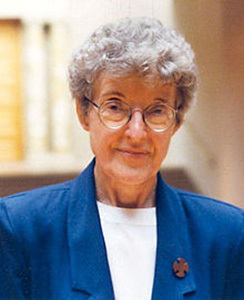
by Delores Dufner, OSB
Tune: THAXTED (Holst)
O Spirit all-embracing and counselor all wise,
Unbounded splendor gracing a shoreless sea of skies:
Unfailing in your treasure, unfading your reward;
Surpassing worldly pleasure, the riches you afford.
Come, stream of endless flowing, and rescue us from death;
Come, wind of springtime blowing, and warm us by your breath.
© 1995, 2003 GIA Publications, Inc. Used by permission. All rights reserved.
Sr. Delores Dufner, OSB (b. 1939) composed this Pentecost hymn as a representation of the Holy Spirit’s presence and power in the world. The author describes the hymn’s themes as expressing “the pervasive presence and transforming power of the Holy Spirit [stanza 1]; the Spirit as a source for growth and new life [stanza 2]; true wisdom and lasting treasure [stanza 3]” (Dufner, 2003, p. 116).
The first four lines of stanza 1 (cited above) describe the Holy Spirit’s limitless essence as “all-embracing,” “all-wise,” “unbounded,” “unfailing,” and “unfading.” Like many historical Pentecost hymns, the last two lines invoke the Spirit—“Come, stream of glory”; “come, wind of springtime.” The Spirit’s breath “rescues us from death” and “warm[s] us.”
Stanza 2 invites us to sense the Spirit’s presence in the natural created order: “ever blazing in flower, field, and face.” In nature, the Spirit “shows [her]self in unexpected place[s].” The manifestation of the Spirit in nature causes us to “remember what once our dreams had been” and “kindle[s] hope within.” Paralleling the final two lines of the first stanza, the poet closes the second stanza by invoking the fire of the Spirit “Come . . . bless all who trust in you . . . and burn in your Church anew.” The author suggests an alternative to the last line, “burn in your world anew”—recognizing the Spirit’s work beyond the doors of the church.
Stanza 3 begins by invoking the Spirit to give us “insight,” “understanding,” “vision,” and “wisdom” as we “wait upon your light.”
Sister Delores sources her text from several biblical passages. The “all-wise” Spirit in stanza 1 resonates with 1 Kings 3:3–10, Proverbs 2:1–11, 3:13–18, 8:1-36, and Wisdom 1:7, 7:22–8:1. The penultimate line of stanza one is inspired by the “rivers of living water” in John 7:37–39. The author of Proverbs 2:1–11 writes about the benefits of wisdom, a quality that comes from the Lord and guides the faithful. The final line of stanza 1 expresses that the warmth of the Spirit breathes wisdom into us.
The Book of Wisdom (1:7, 7:22–8:1), or The Wisdom of Solomon, found in the canons of the Catholic and Eastern Orthodox Churches and in the Apocrypha of Protestants, describes the Spirit filling the world, the theme of stanza 2. 1 Kings 3:3–10 describes Solomon thanking God for showing him his service, and, in return, asking God to give him a discerning heart to help him govern his people. In the third stanza of the hymn, the singers petition God to provide them with an understanding heart, a reminder of Solomon’s encounter with God.
More traditional images of Pentecost found in Acts 2 appear in the references to fire in stanza 2. John 7 reflects on how, if we believe in Christ, we receive the Holy Spirit, an element of Pentecost.
The tune THAXTED is recognizable due to its affiliation with “Jupiter,” the fourth movement of the symphonic work The Planets by prominent early twentieth-century composer Gustav Holst (1874–1934). Holst was born in Gloucestershire of German and Scandinavian heritage. He completed The Planets in 1917. He named the tune THAXTED after his cottage in Thaxted, a town in northwest Essex, England, where he wrote Jupiter. In Canada and the UK, this tune has a long association with the quasi-patriotic hymn growing out of World War I, “I Vow to Thee, My Country” (1918) by Canadian diplomat Cecil Spring Rice (1859–1918). In the United States, the tune has become prominent as a companion to “O God Beyond All Praising” (1981) by Anglican clergyman Michael Perry (1942–1996). Sr. Delores found an affinity between the themes in Perry’s hymn and her Pentecost text.
Musically, the hymn cycles between the home key, B flat, and the relative minor, G minor. The piece begins with an E-flat chord, immediately followed by a B flat, then a deceptive cadence to G minor. The melody repeats and then resolves to B-flat major. As the fire of the Holy Spirit, the hymn’s flame flickers back and forth from B flat and G minor as a fire would. This hymn is sure to be a reminder of God’s love and the wisdom of the Holy Spirit in us.
Delores Dufner is a sister in the Order of St. Benedict in St. Joseph, Minnesota, a Benedictine convent. She holds degrees in sacred music and liturgical studies. She is a member of the Hymn Society in the United States and Canada, the National Pastoral Musicians (NPM), the Monastic Worship Forum, and the American Society of Composers, Authors, and Publishers (ASCAP). She began her career as a school music teacher, private piano and organ teacher, and parish organist and choir director. She was named a Fellow for the Hymn Society (2013), received a lifetime achievement award from the National Association of Pastoral Musicians (2014), and accepted the Christus Rex Award (2017) from the Valparaiso University Institute for Liturgical Studies. “O Spirit All-Embracing” was commissioned by the Diocese of St. Cloud, Minnesota, where she was director of the Diocesan Office of Worship for fifteen years. She has published five collections of her hymns. This hymn first appeared in her collection, The Glimmer of Glory in Song (2003) and subsequently in four hymnals in the United States.
SOURCES:
Delores Dufner, The Glimmer of Glory in Song (Chicago: GIA Publications, Inc., 2003).
“Interview with Delores Dufner, OSB,” Sing! The Center for Congregational Song, https://congregationalsong.org/interview-with-delores-dufner-osb/ (accessed April 21, 2025).
Michael Silhavy, “Delores Dufner,” The Canterbury Dictionary of Hymnology. Canterbury Press, http://www.hymnology.co.uk/d/delores-dufner (accessed June 18, 2025).
John DuBois is a master of sacred music in choral conducting student at Southern Methodist University (SMU), where he is expected to graduate in 2026. He also holds a degree in voice performance from Texas Christian University (BM, 2024). At SMU, he studies with Dr. Marcell Silva Steuernagel and serves as a staff chorister at Highland Park United Methodist Church.
Contact Us for Help
Contact Discipleship Ministries staff for additional guidance.